
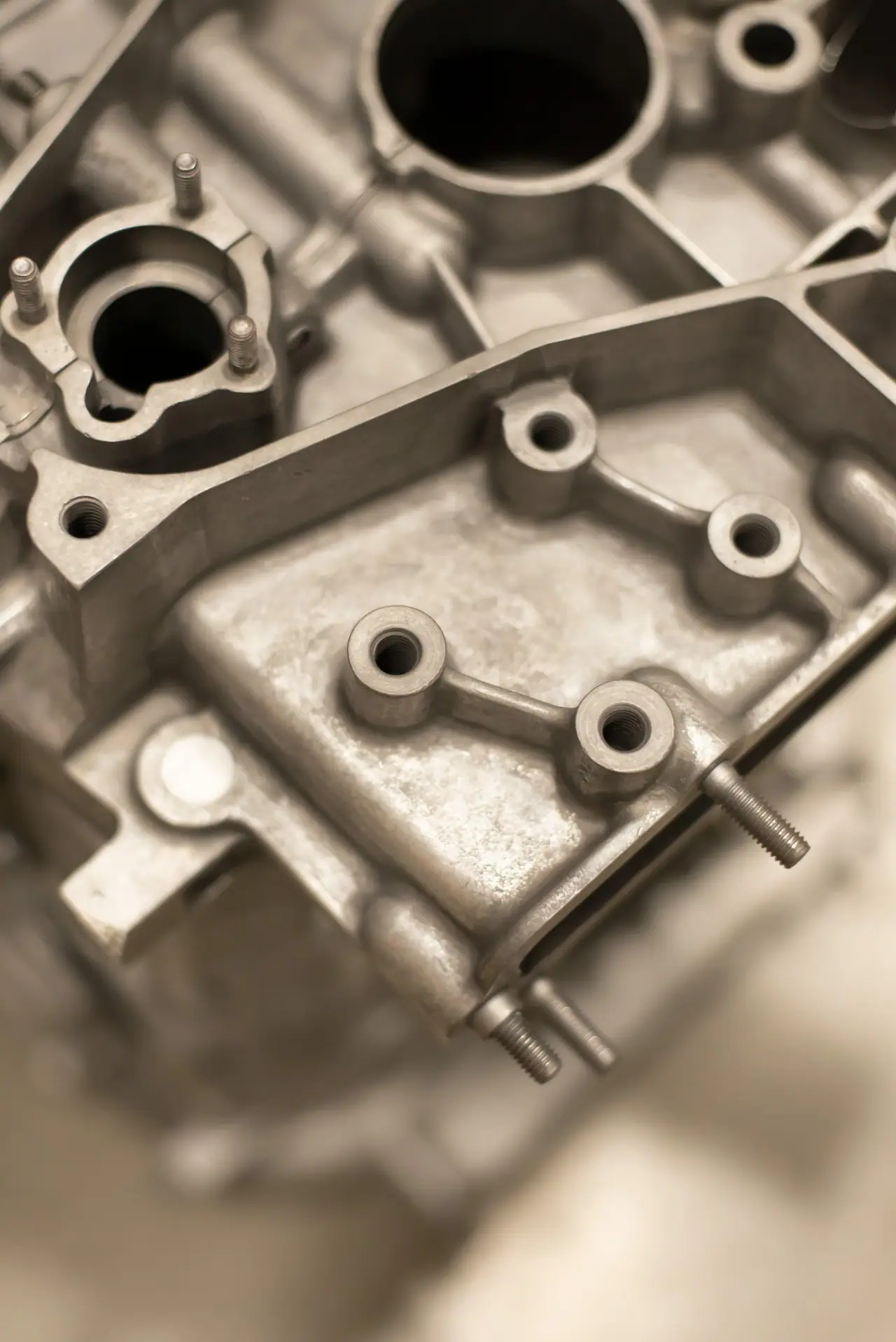
A cylinder head needs resurfacing when its gasket face is warped beyond the manufacturer's flatness limit, or is pitted, eroded, or scratched where the gasket seals. Check it with a precision straightedge and feeler gauge after any overheat or head gasket failure. Always compare against the service manual spec, not a general rule.
Why does a cylinder head warp?
A head gasket seals combustion pressure, coolant, and oil between the head and the block. It can only do that against a flat, clean surface. The most common cause of warp is overheating: a head that gets far hotter than normal, from a coolant leak, a failed water pump, or a stuck thermostat, can distort as it heats and cools.
Aluminum heads on iron blocks are especially sensitive, because aluminum expands about twice as much as iron with temperature. Uneven or incorrect torque during assembly, and damage during removal, can also leave a head out of flat.
What are the signs of a failed head gasket?
Gasket failure is often the reason a head comes off in the first place. Common signs:
- Coolant loss with no visible external leak
- White exhaust smoke with a sweet smell, especially at start-up
- Overheating, or bubbles in the coolant reservoir with the engine running
- Combustion gases detected in the coolant with a chemical block tester
- Low compression or high leakdown on two neighboring cylinders
- Oil and coolant mixing (milky oil can also come from condensation on short trips, so confirm with other tests)
- External oil or coolant seeping from the head-to-block joint
A blown gasket is often a symptom. If the head is warped or the surface is damaged, a new gasket on the old surface may fail again.
How do I check a head for warp?
You need a precision straightedge long enough to span the head, a set of feeler gauges, and the service manual.
- Clean the deck completely. Remove every trace of old gasket and carbon. Use a plastic scraper or a method approved for the head material; aggressive abrasive discs can remove metal and round edges, especially on aluminum.
- Lay the straightedge on edge across the gasket surface.
- Check in several directions: lengthwise down the center, along both sides, across the ends, across the middle, and on both diagonals.
- At each position, find the largest feeler gauge that slides under the straightedge.
- Compare the readings to the manufacturer's flatness limit. Some manuals give one limit for the full length and a tighter one for any short span.
- Check the manifold faces too if the manual gives limits for them.
If any reading exceeds the limit, the head needs resurfacing or replacement.
Why does the manufacturer's spec matter so much?
Flatness limits are not universal. They depend on the head material, the head length, the clamp load of the head bolts, and the gasket design. A limit that is fine for one engine can leak on another. Multi-layer steel (MLS) gaskets, common on modern engines, generally need a flatter and smoother surface than older composite gaskets, and the manufacturer or gasket maker publishes what is required.
That is why this guide does not give a single number. Look it up for your engine and use it.
What should be checked besides flatness?
| Check | Why |
|---|---|
| Cracks between valve seats, at bolt holes, and in water jackets | A cracked head will leak no matter how flat it is |
| Pitting or erosion around coolant passages | Can leave voids the gasket cannot seal |
| Surface finish of the deck | Must suit the gasket type |
| Head height or thickness | Confirms how much material is left to remove |
| Cam bore alignment (overhead cam heads) | Warp can bend the cam bore line, which deck resurfacing does not fix |
| Thread condition in bolt holes | Damaged threads give false torque readings and uneven clamp |
Crack testing is done with methods suited to the material, such as dye penetrant on aluminum or magnetic particle inspection on cast iron, and pressure testing of the water jackets.
What does resurfacing remove, and what does it change?
Resurfacing machines the gasket face flat again by removing a thin layer of metal, only enough to clean up the surface. That small cut has side effects worth knowing:
- Compression ratio rises slightly, because the combustion chamber gets a little smaller.
- On overhead cam engines, cam timing can shift slightly, because the head sits lower relative to the crank.
- On interference engines, valve-to-piston clearance shrinks.
- On V engines, intake manifold alignment changes, since both heads move toward the center of the vee.
Each head has a minimum height or maximum total removal in the service manual. A head that has been resurfaced before may already be near that limit. Measure it before cutting, and keep a record of what was removed.
Resurface, or replace?
Resurfacing makes sense when the head is uncracked, within the manufacturer's machining limits, and the rest of the head (valves, seats, guides, cam bores) is serviceable. Replacement makes more sense when the head is cracked, already at minimum height, or warped beyond what the manufacturer allows to be machined.
Getting a head resurfaced
Culmination Machine Works resurfaces aluminum and cast iron cylinder heads and engine blocks in Anchorage, along with thread repair and custom modifications. The shop is a machine shop, not a repair garage: the head or block comes in off the engine and goes back to you or your mechanic for assembly. See cylinder head and block resurfacing, or contact the shop with the engine make and model, the head material, and the work you need.
Frequently asked questions
Use the flatness limit in the engine manufacturer's service manual. It varies by engine, by head material, and by gasket type, and some manuals give separate limits for the full length and for a short span. If the head is outside that limit, it needs to be resurfaced or replaced.
Not always. If the head is within the manufacturer's flatness limit and the surface is clean and free of pits, scratches, and erosion, it may not need machining. Many builders resurface anyway after an overheat, or when switching to a gasket that calls for a smoother finish.
Only enough to clean up the surface and make it flat. Each head has a minimum height or maximum removal in the service manual. A head that has been cut before may already be close to that limit, so it should be measured before any more is removed.
Often, if the warp is within what the manufacturer allows to be machined and the head has no cracks. On overhead cam heads, warp can also affect the cam bores, which resurfacing the deck does not correct, so check cam bore alignment as well.