
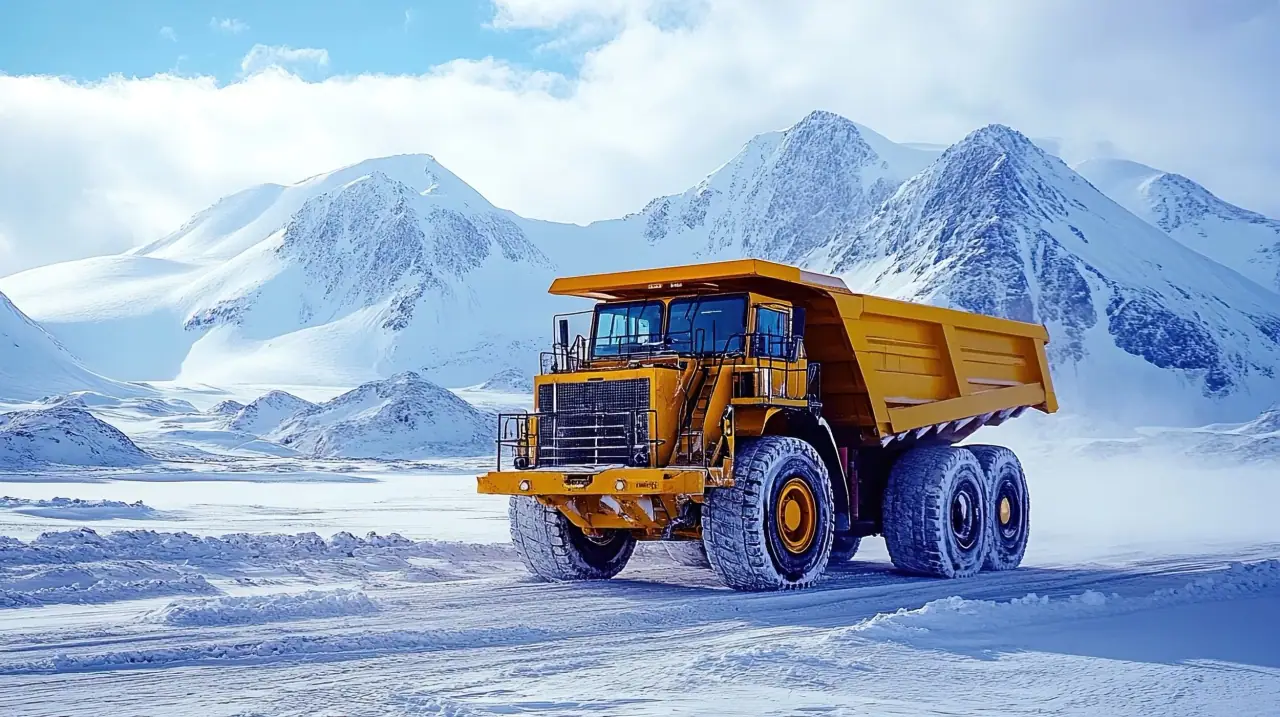
At -40, pick materials that do not go brittle and design fits that allow for shrinkage. Austenitic stainless, aluminum, and copper alloys stay tough. Ordinary carbon steel may not, so specify an impact-tested low-temperature grade for loaded parts. UHMW, PTFE, and polycarbonate stay tough in the cold, and plastics shrink far more than metals.
-40 is the one temperature where Fahrenheit and Celsius agree, and it is a normal winter morning in much of Alaska and northern Canada. Parts that work fine in a heated shop can crack, bind, or leak outside. The rules below are standard metallurgy and apply anywhere that gets that cold.
Why does carbon steel crack in extreme cold?
Carbon and low-alloy steels have a body-centered cubic crystal structure. Steels with that structure have a ductile-to-brittle transition: above a certain temperature they bend and tear before they break, and below it they can fracture suddenly, with very little energy, especially from a notch, a sharp corner, or a weld defect.
Where that transition falls varies by grade, heat treatment, cleanliness, and section thickness. Some ordinary structural steels can lose much of their toughness at temperatures well above -40. This is why cold-service specifications measure toughness directly with a Charpy V-notch impact test at a stated temperature.
What that means for a part:
- Do not assume a general structural grade is suitable for cold service. ASTM A36, for example, has no impact test requirement unless one is ordered as a supplementary requirement.
- Specify a low-temperature grade for loaded parts. Examples include ASTM A333 Grade 6 pipe and ASTM A350 LF2 Class 1 forgings, both impact tested at -50 F, and ASTM A320 L7 bolting. Plate such as A516 can be ordered with impact testing.
- Ask for the mill test report so you can see the actual Charpy results.
Which metals stay tough at -40?
Metals with a face-centered cubic structure do not have a sharp ductile-to-brittle transition. They keep their toughness at -40 and far below it, which is why they are used for cryogenic equipment.
| Material | Behavior in deep cold | Notes |
|---|---|---|
| Austenitic stainless (304, 316) | Stays tough far below -40 | 316 adds chloride resistance for salt exposure |
| Aluminum alloys (6061, 7075, 5052) | Stays tough; strength rises slightly | Watch thermal contraction against steel |
| Copper, brass, bronze | Stays tough | Common for bushings and fittings |
| Impact-tested low-temperature carbon steel | Tough down to its tested temperature | Check the Charpy results on the mill report |
| Ordinary carbon steel, no impact test | Unknown; may be brittle | Avoid for shock-loaded parts in the cold |
| Martensitic and precipitation-hardening stainless (410, 17-4 PH) | Toughness drops at low temperature | Check impact data for the heat-treat condition |
| Gray cast iron | Brittle at any temperature | Avoid for impact loads |
| Hardened tool steels | Low toughness, lower in the cold | Fine for wear, poor for impact |
Does design matter as much as material?
Yes. Brittle fracture starts at stress concentrations. Even with a good material, a cold part lasts longer if it has:
- Generous radii at inside corners instead of sharp steps
- No unnecessary notches, scribe marks, or stamped lettering in high-stress areas
- Smooth transitions between thick and thin sections
- Sound welds with no undercut, and weld procedures qualified for low-temperature service where codes require it
A part that fails at a sharp corner in the cold is often better fixed with a larger radius than with an exotic alloy.
Which plastics work at -40?
Many plastics stiffen and become more brittle as they get colder. Some handle it much better than others.
- UHMW polyethylene keeps its impact strength at very low temperatures and absorbs almost no water. It is the usual choice for wear strips, chute liners, guides, and snow and ice contact surfaces.
- PTFE stays flexible at very low temperatures and is used in cryogenic seals.
- Polycarbonate keeps good impact strength to around -40, which is why it is used for outdoor guards and windows.
- Acetal (Delrin) absorbs little water and holds its dimensions well. It is a good choice for precise parts, but it is less impact resistant than UHMW, so avoid it where parts take hard hits in the cold.
- Nylon is tough and wears well, but it absorbs water. Nylon 6/6 takes up about 2.5 percent water by weight at 50 percent relative humidity and up to about 8 percent when saturated, and it swells as it does. A nylon bushing sized in a dry winter shop can grow in a wet summer, and dry nylon is less impact resistant than conditioned nylon.
- PVC and acrylic become brittle in the cold. Avoid them for anything that takes impact outdoors.
How much do parts shrink at -40?
Everything contracts as it cools, and different materials contract by different amounts. Typical coefficients of thermal expansion:
| Material | Expansion per degree F | Change in 10 in. from 70 F to -40 F |
|---|---|---|
| Carbon steel | about 6.5 millionths | about 0.007 in. |
| 304 stainless | about 9.6 millionths | about 0.011 in. |
| Aluminum | about 13 millionths | about 0.014 in. |
| UHMW polyethylene | roughly 100 millionths | roughly 0.1 in. |
Plastics vary by grade, so treat the UHMW figure as an order of magnitude and check the supplier's data sheet for the exact grade.
Three practical effects:
- An aluminum housing shrinks onto a steel bearing or shaft. A 2 inch aluminum bore closes about 0.003 inch from 70 F to -40 F, while the steel inside shrinks about half that. A slip fit at room temperature can become tight at -40.
- A steel shaft in an aluminum bore gains clearance when hot and loses it when cold. Size fits for the full temperature range the part will see, not only the shop temperature.
- Long plastic parts need room to move. A 10 foot UHMW wear strip can change length by more than an inch over a wide seasonal range. Use slotted holes and leave end gaps.
What else changes in the cold?
- Elastomer seals and O-rings lose elasticity and can leak. Choose a compound rated for the low temperature.
- Grease and oil thicken, which raises start-up loads on gears, bearings, and shafts.
- Thermal cycling between a heated building and the outdoors loosens bolted joints over time and can open gaps at mixed-material joints.
Getting cold-service parts made
Culmination Machine Works machines aluminum, stainless, steels, tool steels, copper alloys, titanium, and engineering plastics including Delrin, UHMW, and nylon. Tell us where the part lives and how cold it gets, and we will help you choose a material. See the materials guide and industrial equipment parts repair, or send the drawing or the failed part to start a quote.
Frequently asked questions
Ordinary carbon and low-alloy steels can. They have a ductile-to-brittle transition, and below that temperature a notched part can fracture suddenly with little energy. Where the transition falls depends on the grade, the heat treatment, and the section thickness, which is why cold-service specifications require Charpy impact testing at a stated temperature.
Austenitic stainless steels such as 304 and 316, aluminum alloys, and copper alloys do not show a sharp ductile-to-brittle transition and stay tough far below -40. Carbon steels made and tested for low-temperature service, such as ASTM A333 Grade 6 pipe and A350 LF2 forgings, are also used in cold service.
For wear parts outdoors in the cold, UHMW is usually the safer choice. It keeps its impact strength at very low temperatures and absorbs almost no water. Nylon absorbs water from the air and swells as it does, which changes its dimensions with the seasons.
Aluminum contracts about 13 millionths of an inch per inch for every degree Fahrenheit. Going from 70 F to -40 F, a 2 inch dimension shrinks about 0.003 inch. Steel shrinks about half as much, so mixed aluminum and steel fits change as the temperature drops.